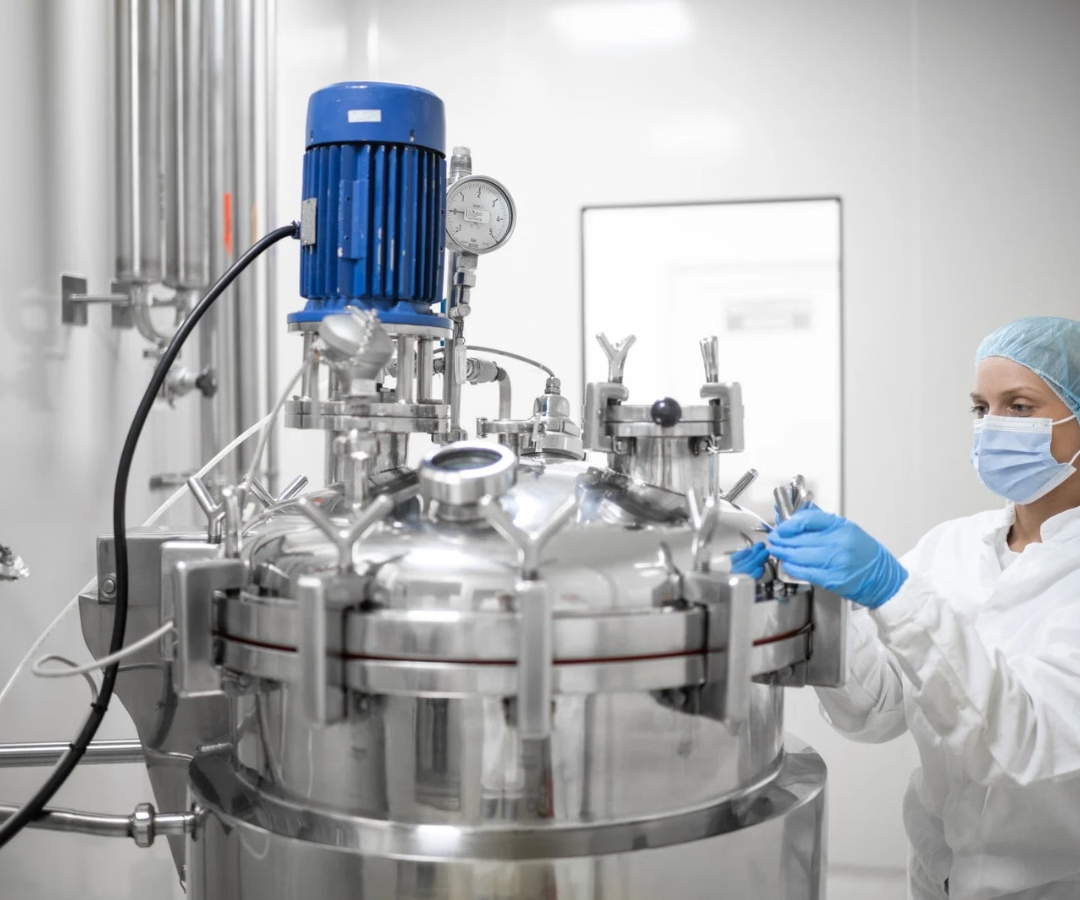
Walk through the door of a pharmaceutical manufacturing facility and the air quality conversation changes immediately. It’s not just about airflow and filter efficiency — it’s about contamination control, cross-contamination between product runs, occupational exposure limits measured in micrograms rather than milligrams, and a regulatory overlay that requires your dust collection system to be documented, validated, and auditable.
Add the combustible powder risk — most pharmaceutical excipients and a significant number of APIs are confirmed St-1 combustible — and you have an environment where the wrong filter bag isn’t just inefficient. It’s a liability.
This guide is written from the perspective of a filter bag and cartridge fabricator, not a dust collector OEM. If you already have collectors installed — whether they’re Camfil, Donaldson, Torit, Farr, or a discontinued brand with no available OEM replacement — the critical decisions aren’t which collector to buy. They’re which filter media to run in it, what GMP construction requirements your bags need to meet, whether your current bags are anti-static for combustible powder, and whether you have the material traceability documentation your quality system requires.
Why Pharmaceutical and Nutraceutical Dust Collection Is Different From Every Other Industry
Most industrial dust collection applications have one primary compliance driver — OSHA exposure limits, EPA emission standards, or NFPA combustible dust requirements. Pharmaceutical and nutraceutical facilities run under all three simultaneously, plus a fourth framework that no other industry operates under: FDA Current Good Manufacturing Practice (cGMP).
These aren’t independent requirements you can manage separately. They interact. A filter changeout procedure that makes sense from a safety standpoint needs to also satisfy cGMP documentation requirements. A filter bag material that performs well technically may not be traceable to a GMP-acceptable supply chain. An anti-static bag that controls combustible dust risk may need to be validated as part of your quality management system before it goes into a regulated product environment.
The four overlapping regulatory frameworks for pharmaceutical and nutraceutical dust collection:
- FDA 21 CFR Part 211 (cGMP for Finished Pharmaceuticals) — Section 211.46 specifically requires that HVAC and dust collection systems be designed to prevent contamination and cross-contamination. This means the dust collection system is part of your quality system, not just your facilities system. Equipment must be documented, maintained under your quality program, and capable of being cleaned to validated standards between product runs.
- NFPA 660 (effective January 1, 2026) — NFPA 660 is the consolidated combustible dust standard that replaced NFPA 652, 654, 655, 656, NFPA 61, and NFPA 484. As of January 2026, it is the single governing standard for combustible dust hazard management. For pharmaceutical facilities, it requires a formal Dust Hazard Analysis (DHA), documented engineering controls, and explosion protection for any process handling combustible dust — which includes most solid-dose pharmaceutical and nutraceutical manufacturing.
- OSHA Permissible Exposure Limits — Many APIs and nutraceutical compounds have occupational exposure limits (OELs) in the microgram range. The dust collection system is the primary engineering control for keeping worker airborne exposure below those limits. When OELs are this low, even a brief filter bypass event during changeout is a reportable exposure incident.
- 40 CFR Part 63, Subpart GGG (NESHAP for Pharmaceutical Production) — Sets emission limits and work practice standards for hazardous air pollutant (HAP) emissions associated with pharmaceutical production. Dust collection is a primary control mechanism under this standard.
The practical consequence of all four running simultaneously: a filter bag in a pharmaceutical dust collector isn’t just a consumable. It’s a component in a regulated quality system that must be specified, documented, installed, changed, and disposed of under controlled procedures — and replaced only with a like-for-like or qualified upgrade that doesn’t require revalidation of the system.
Combustible Pharmaceutical and Nutraceutical Powders: What NFPA 660 Actually Requires
The combustible dust risk in pharmaceutical and nutraceutical manufacturing is not theoretical. The most common pharmaceutical excipients — lactose, starch, microcrystalline cellulose, sucrose, and maltodextrin — all have confirmed St-1 or St-2 KSt values. Many API powders are also combustible. In a nutraceutical facility, protein powders, herbal extracts, plant-based supplements, and botanical ingredients frequently carry the same combustibility risk.
Under NFPA 660, any facility handling combustible dust is required to:
- Conduct and document a Dust Hazard Analysis (DHA) for each process area handling combustible dust, covering the five elements of the dust explosion pentagon: combustible fuel, oxidizer, ignition source, confinement, and dispersion.
- Implement engineering controls — explosion venting sized per NFPA 68, deflagration isolation valves on inlet and outlet ducts, and grounding and bonding for all equipment handling combustible powder.
- Use anti-static or conductive filter media in dust collectors handling combustible powder. Standard synthetic filter bags that accumulate electrostatic charge are not appropriate and can serve as ignition sources.
- Maintain documented management programs — housekeeping procedures to prevent secondary dust accumulation, inspection records, DHA review schedules, and equipment maintenance records.
What changed with NFPA 660’s consolidation isn’t the underlying technical requirements — explosion venting, grounding, anti-static media, and DHA documentation were already required under NFPA 652 and 654. What changed is that your compliance pathway is now unified, your DHA framework applies across your entire facility regardless of which specific dust types you handle, and AHJs, OSHA, and insurers are actively referencing NFPA 660 in 2026 inspections.
If your current filter bags in a pharmaceutical dust collector are standard polyester or polypropylene without anti-static treatment, that’s a NFPA 660 compliance gap.
Combustibility of Common Pharmaceutical and Nutraceutical Powders
| Common pharmaceutical / nutraceutical powder | Combustibility class | Typical KSt range (bar·m/s) | Anti-static media required? |
|---|---|---|---|
| Lactose | St-1 | 50–100 | Yes |
| Starch (corn, potato) | St-1 | 100–200 | Yes |
| Microcrystalline cellulose (MCC) | St-1 | 50–150 | Yes |
| Sucrose / powdered sugar | St-1 | 100–150 | Yes |
| Whey / dairy protein concentrate | St-1 | 100–200 | Yes |
| Maltodextrin | St-1 | 100–175 | Yes |
| Herbal / botanical extracts (spray-dried) | St-1 (most) | 50–150 | Yes — test to confirm |
The original chart compared typical KSt values for starch, whey protein, maltodextrin, sucrose, microcrystalline cellulose (MCC), lactose, and botanical extracts. The listed excipients fall within the St-1 range; botanical extracts should be tested to confirm their properties, and most API powders require product-specific testing.
GMP Construction Requirements for Pharmaceutical Filter Bags
This is where the pharmaceutical specification diverges most sharply from standard industrial practice — and where generic replacement bags from an industrial catalog consistently fail audit.
In a pharmaceutical or nutraceutical facility operating under cGMP, the filter bag is a direct-process contact component. Particles shed from the bag media, seam thread, or cage contact surface can contaminate product. Materials that migrate from the bag into the process airstream — dyes, finishes, sizing agents, or non-traceable resin components — become potential adulterants.
GMP construction requirements for pharmaceutical dust collection filter bags:
- Traceable, documented material supply chain — Every component of the filter bag (media, seam thread, ring gasket, cage material if applicable) must be traceable to a documented material specification. Your quality system requires this to qualify the bag as a controlled component. AFF provides full material traceability documentation on pharmaceutical-grade filter bags.
- No dyes, optical brighteners, or fugitive finishes — Standard polyester and polypropylene filter media is often treated with optical brighteners that can shed into the process airstream. Pharmaceutical-grade filter bags are manufactured from undyed, untreated, pure fiber media.
- Seam construction compatible with cleanability — Seam type affects how well the bag can be inspected and how easily product accumulates in seam pockets. Smooth interior seams with no exposed thread on the product-contact side are the standard for pharmaceutical applications.
- Anti-static or static-dissipative media — Required under NFPA 660 for combustible powder service. Anti-static media uses conductive fiber woven into or blended with the filter media; static-dissipative fabrics use a treated surface. The choice depends on the specific resistivity requirement in your DHA.
- Single-use design where product changeover is required — In multi-product facilities, single-use filter bags eliminate the risk of API carryover between product runs. Single-use bags are disposed of with the product batch; housing and cage are cleaned between runs.
- Documentation package for IQ/OQ — Installation qualification and operational qualification of the dust collection system requires component documentation, including filter bag material certs, dimensional specs, and manufacturer quality certifications. AFF supplies the documentation package required for your validation master file.
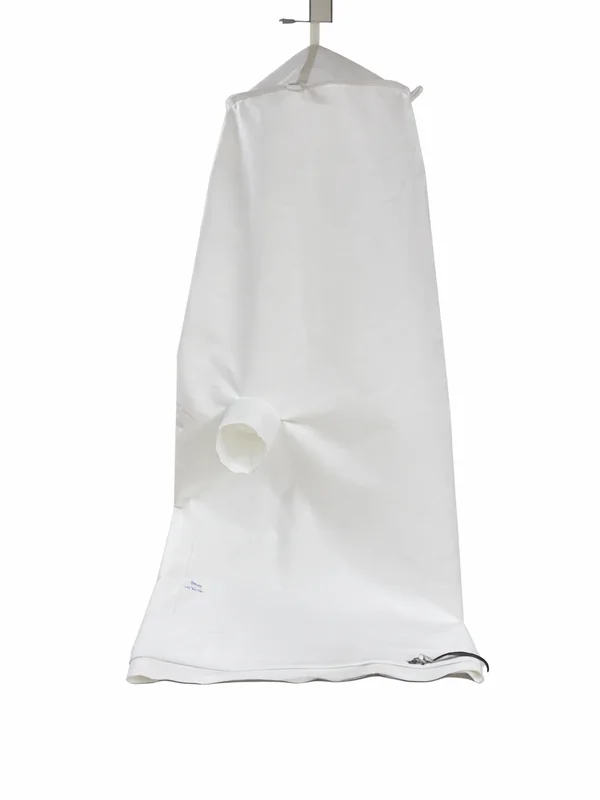
Fluid Bed Dryer Filter Bags: The Most Demanding Pharmaceutical Application
Fluid bed dryers (FBDs) are the highest-demand filter bag application in pharmaceutical manufacturing. The filter bags in an FBD aren’t just capturing dust — they’re directly retaining product during the drying cycle, then releasing it back into the product stream as the bags are shaken or pulse-cleaned. In a tablet granulation or coating operation, the FBD filter bags directly affect product yield and product quality, not just air quality.
The specific requirements for fluid bed dryer filter bags in pharmaceutical service:
- High particle retention efficiency — FBD bags must retain fine API and excipient particles through extended drying cycles. Pore size, media construction, and surface finish all affect retention efficiency.
- Clean product release during pulse cleaning — PTFE membrane surface treatment or specific fiber geometry, such as P84’s trilobal cross-section, allows the dust cake to release cleanly back into the product bed during pulse cycles, maximizing yield recovery.
- Resistance to moisture and temperature in the drying environment — FBD operation involves heated, humid process air. Filter media must maintain structural integrity and filtration efficiency throughout repeated wet-dry cycles.
- GMP seam and finish construction — Attention to the bag’s ability to withstand the mechanical stress of repeated pulse cleaning cycles without seam failure or fiber shedding into product.
- Anti-static treatment for combustible powder service — FBD operations with lactose, starch, or API powders require anti-static FBD bags under NFPA 660.
- Exact dimensional match to equipment — FBD bags are fitted to specific dryer models; dimensional tolerance directly affects the seal at the bag-to-tube-sheet interface. A bag that doesn’t seat precisely bypasses product-laden air around the filter, losing both yield and compliance. AFF fabricates FBD bags to exact equipment dimensions.
Filter Media Options for Pharmaceutical Dust Collectors
| Media type | Pharmaceutical application | Anti-static version? | GMP grade? | Key strength |
|---|---|---|---|---|
| Polyester felt | Baghouse and cartridge collectors, general excipient handling | Yes — conductive fiber blend | Yes — undyed, untreated | Cost-effective; excellent dust cake release with PTFE membrane upgrade |
| Polypropylene felt | Low-temperature applications, chemical-resistant requirements | Yes | Yes | Chemical resistance, moisture resistance, FDA-listed material |
| PTFE membrane over polyester | API dust collection, high-efficiency excipient recovery, FBD bags | Yes — anti-static substrate | Yes | Surface filtration — maximum collection efficiency, cleanest product release |
| P84 (polyimide) felt | Spray drying, high-temperature applications, difficult cake release | Yes | Yes | Trilobal fiber cross-section — superior dust cake release in sticky or hygroscopic powders |
| Nylon monofilament | Fluid bed dryer bags, product recovery applications | Available | Yes | Precision weave — exact pore sizing for product retention at defined particle cut points |
| Woven polyester | Applications where mechanical strength and cake release are priorities | Yes | Yes | High tensile strength, good cleanability
|
For most pharmaceutical baghouse and cartridge collector applications, the standard recommendation is anti-static polyester felt with a PTFE membrane surface layer. The PTFE membrane provides the filtration efficiency required to meet OEL targets, the clean cake release that extends filter service life between changeouts, and the surface filtration mechanism that keeps API particles from embedding in the filter depth — which matters both for product yield and for validated cleaning effectiveness.
Filter media selection: pharmaceutical dust collection applications
The original comparison chart evaluated three media configurations across filtration efficiency, dust cake release, temperature resistance, ease of GMP compliance, and cost efficiency:
- PTFE membrane over polyester: Highest relative filtration efficiency and dust cake release in the comparison, with good GMP compliance ease.
- Anti-static polyester felt: Strong relative cost efficiency and GMP compliance ease.
- P84 (polyimide): Strong relative dust cake release and temperature resistance.
Actual media selection should be based on the specific process, operating conditions, combustible dust assessment, and documentation requirements.
OEM Replacement Filter Bags for Existing Pharmaceutical Collectors
A significant challenge in pharmaceutical facilities is continuity of supply for filter bags in validated dust collection systems. Many facilities are running collectors whose original manufacturers no longer support the equipment — discontinued brands, acquired product lines, or collectors that are 15–20 years old and no longer in the OEM’s catalog.
Changing to a different filter bag in a validated pharmaceutical system can trigger a requalification requirement under 21 CFR Part 211. When the OEM bag is simply unavailable, facilities have two options: validate a new bag from a qualified supplier, or find a fabricator who can produce an exact dimensional and material match to the original.
AFF’s position here is specific: as a fabricator rather than an OEM, AFF can reproduce any filter bag to exact dimensional specifications in the same material as the original — or in an upgraded material that maintains the critical dimensional parameters while improving performance. The documentation package for the replacement bag supports your change control process without requiring full revalidation when the replacement is a like-for-like match.
If you’re running bags in a discontinued pharmaceutical dust collector and have had difficulty sourcing replacements, send AFF your existing bag or its dimensional specs and material description. AFF will match it.
Cross-Contamination Control in Multi-Product Pharmaceutical Facilities
In a single-product pharmaceutical facility, filter bag selection is primarily a performance and compliance decision. In a multi-product facility — where different APIs or products run across the same equipment on a campaign basis — filter bag management becomes a contamination control decision with direct product safety implications.
The contamination control strategies for filter bags in multi-product service:
- Single-use filter bags — Disposed of with each product batch, eliminating carryover risk. Standard for high-potency API operations (OEB 3 and above) where residual contamination is unacceptable.
- Validated cleaning procedures — For facilities where single-use is not practical, validated cleaning of the filter bag and housing between product runs must demonstrate that API residues are below the acceptable daily exposure (ADE) or permitted daily exposure (PDE) threshold for the next product.
- Dedicated collectors per product — In facilities with sufficient capital, dedicated dust collectors per product line eliminate the cross-contamination variable. Filter bags are replaced on performance criteria, not contamination control criteria.
- Allergen isolation for nutraceutical facilities — Where allergen-containing ingredients are processed alongside allergen-free products, filter bags and housings must be managed under the facility’s allergen control program. In practice, this typically means single-use bags or dedicated collectors for allergen product lines.
What to Specify When Ordering Pharmaceutical-Grade Filter Bags
To receive an accurate quote and the right documentation package from AFF, provide the following:
- Collector type, model, and manufacturer — Baghouse, cartridge collector, fluid bed dryer, or other; OEM brand and model if known.
- Current bag dimensions — Diameter and length for round bags; all relevant dimensions for FBD bags.
- Current media type and any known GMP certifications — From existing bag documentation if available.
- Dust type and process — Excipient type, API class, nutraceutical ingredient, and whether the powder is confirmed combustible.
- Operating temperature and humidity — Especially relevant for FBD and spray dryer applications.
- Anti-static requirement — Whether your DHA specifies conductive or static-dissipative media and to what resistivity level.
- Single-use vs. reusable — Single-product vs. multi-product facility; potency class if relevant.
- Documentation requirements — Material certifications, dimensional inspection records, and IQ/OQ support package.
- Facility type — FDA-inspected pharmaceutical, cGMP nutraceutical, dietary supplement (21 CFR Part 111), or food processing with nutraceutical ingredients.
Contact AFF at 1-877-742-3653 or request a quote for pharmaceutical dust collection filter bags.
Why AFF for Pharmaceutical and Nutraceutical Dust Collection Filter Bags
Donaldson, Camfil, and the other dust collector OEMs sell systems. When those systems need replacement bags — whether the system is five years old or twenty — the question is who fabricates the filter bag to the spec your validated system requires.
Pharmaceutical and nutraceutical filtration has been a core application area at AFF since the company’s founding. What AFF brings to pharmaceutical and nutraceutical filter bag supply:
- Custom fabrication to exact dimensional specifications — including obsolete and discontinued collector models.
- Anti-static and static-dissipative filter media in polyester, polypropylene, PTFE membrane, P84, and nylon.
- Pharmaceutical-grade media — undyed, untreated, traceable to GMP-acceptable material supply chains.
- Full material traceability documentation to support change control and IQ/OQ qualification.
- Fluid bed dryer filter bags fabricated to equipment-specific dimensions for all major FBD platforms.
- Single-use and reusable configurations.
- Fast lead times — in-house fabrication means AFF is not subject to OEM supply chain delays.
Contact AFF at 1-877-742-3653 or request a quote.
Frequently Asked Questions: Pharmaceutical and Nutraceutical Dust Collection
What is NFPA 660 and does it apply to my nutraceutical facility?
NFPA 660 is the consolidated combustible dust standard effective January 1, 2026. It replaced NFPA 652, 654, 655, 656, 61, and 484 into a single unified standard. It applies to any facility handling combustible dust — which includes virtually all solid-dose nutraceutical and pharmaceutical manufacturing. The standard requires a Dust Hazard Analysis, documented engineering controls, and explosion protection for affected systems.
Do my pharmaceutical dust collection filter bags need to be anti-static?
If your dust collector handles combustible powder — lactose, starch, MCC, sucrose, protein powders, or most API powders — anti-static or conductive filter media is required under NFPA 660. Standard synthetic filter bags accumulate electrostatic charge and can serve as ignition sources in a combustible dust environment. AFF supplies anti-static filter bags in all standard pharmaceutical media types.
What makes a filter bag “pharmaceutical grade” vs. standard industrial?
Pharmaceutical-grade filter bags are manufactured from traceable, undyed, untreated media with no fluorescent brighteners or finishing agents that could migrate into the process airstream. They include material documentation to support GMP change control and IQ/OQ qualification. The seam construction is compatible with validated cleaning procedures. Standard industrial bags may use the same base fiber but lack the documentation and construction details a regulated pharmaceutical environment requires.
Can AFF supply replacement bags for my existing pharmaceutical dust collector?
Yes. AFF fabricates replacement filter bags to exact dimensional specifications for any collector, including discontinued and obsolete models where the OEM no longer supplies replacement bags. Provide your existing bag or its dimensional and material specifications and AFF will match it — with the documentation package your quality system requires.
Are fluid bed dryer filter bags different from standard baghouse bags?
Significantly. FBD filter bags are direct product-contact components — they retain product during the drying cycle and release it back into the product stream during pulse cleaning. They require precise dimensional fit, high product retention efficiency, clean cake release, and resistance to repeated wet-dry cycles. Their specification is driven by both filtration performance and product yield requirements, not just air quality compliance.
How do I handle filter bags in a multi-product facility to prevent cross-contamination?
The three standard approaches are single-use bags (disposed with each product batch), validated cleaning procedures between product runs, or dedicated collectors per product line. For high-potency APIs, single-use is the standard. The right approach depends on your product potency class, OEL/ADE values, and cleaning validation capability.