Screening Media

Stainless Steel Wire Mesh and Nylon Screening Media

AFF stocks a large amount of screen mesh. We carry all the popular mesh sizes in stainless steel woven wire mesh and nylon, with full specifications below for every mesh we offer.

Stocked Mesh

Popular sizes on hand.

Stainless and Nylon

Wire cloth and monofilament.

304, 316 and 430

Stainless steel types.

Screens Built

Mesh made into screens.

Mesh Size Charts

Find the Right Screen Mesh

Jump to the specifications for each type of screening media, from fine nylon to heavy market grade wire cloth.

Nylon Mesh

Fine monofilament fabrics.

Market Grade

Heavy wire, most strength.

Bolting Cloth

Fine wire, most open area.

Mill Grade

Strength and capacity.

Mesh Basics

How to Read a Screen Mesh Chart

Screening media is the woven mesh that does the separating in a sifter, vibratory separator or screener. Each screen mesh is defined by a few numbers. Mesh count is the number of openings per linear inch. Wire diameter is the thickness of the wire or monofilament. The mesh opening is the clear space between the wires, and it sets the particle size that passes through.

Open area is the share of the screen surface that is open space. A thinner wire gives more open area and more throughput capacity. A thicker wire gives a stronger, longer lasting screen with less open area. Choosing the right mesh means balancing particle size, throughput and screen life for your product.

Screening media is woven wire mesh, not welded wire mesh. In a woven wire cloth the wires pass over and under each other in a tight weave that holds a precise opening size, which is what accurate sizing, sifting and filtration need. Welded wire mesh, with wires welded where they cross, is built for guards and panels rather than fine separation.

Stainless steel wire cloth comes in three grades: market grade, mill grade and bolting cloth. Nylon monofilament mesh covers the very fine openings, measured in microns.

Warning Signs

Signs Your Screen Mesh Needs Replacing

  • Tears, holes or broken wires in the mesh

  • Oversize particles showing up in the fines

  • Blinding that cleaning will not clear

  • Loose or uneven screen tension

  • Capacity drops off at normal feed rates

Fighting blinding? See our sifter cleaner balls →

Nylon Screen Mesh

Nylon Monofilament Mesh

Nylon screen mesh is woven from precise monofilament threads, which gives an exact, consistent mesh opening. Our nylon fabrics run from mesh openings of a few microns up to 90 microns, for fine sifting, straining and separating where a stainless steel wire would be too coarse.

The chart below lists our common and special order nylon fabrics with the mesh opening, open area, thread count, thread diameter, weight and thickness of each.
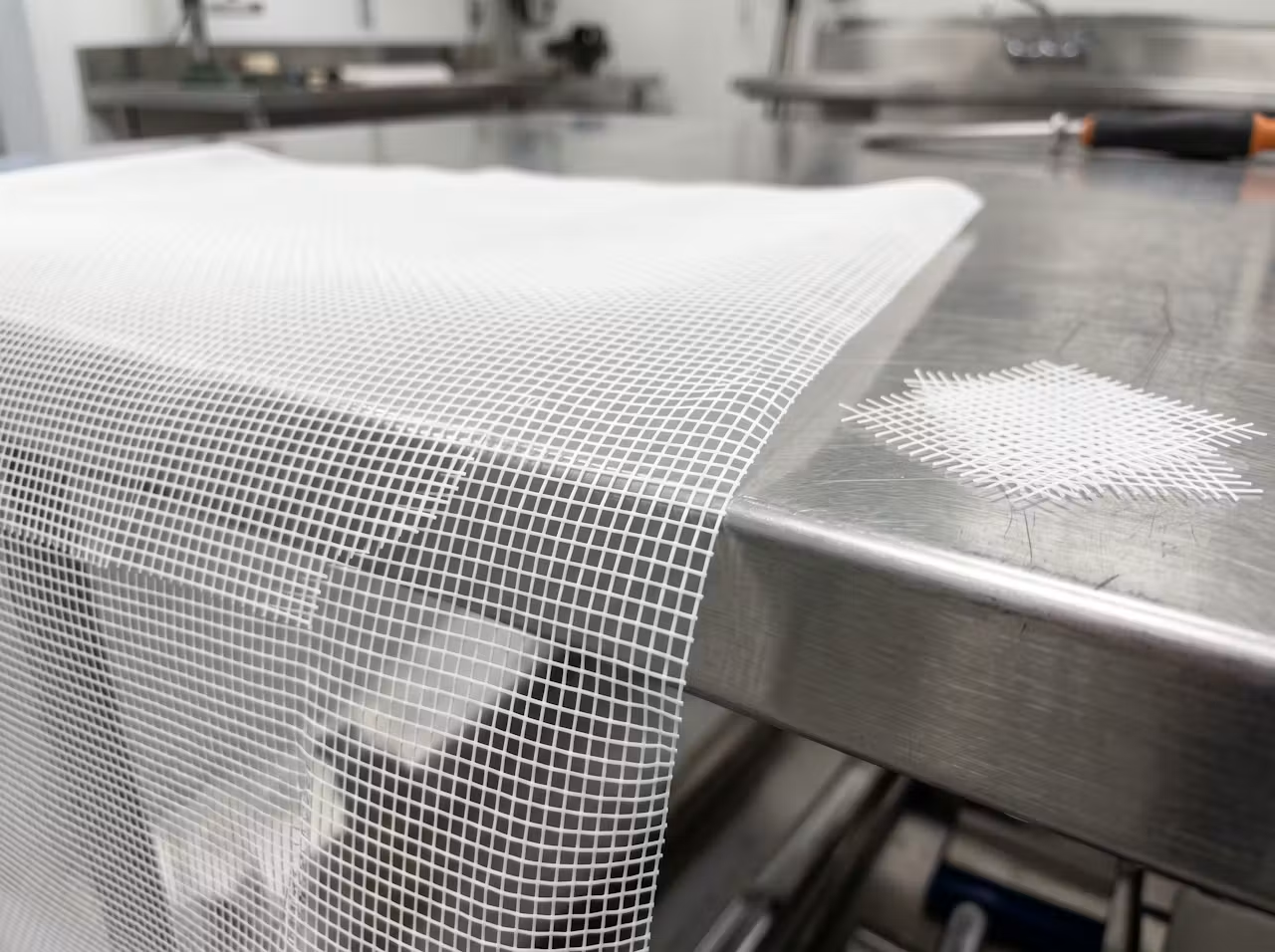
White nylon monofilament screen mesh draped over a stainless steel table

Monofilament weave

Micron openings

Common and special order

Lightweight

Nylon Mesh Chart

Nylon Screen Mesh Specifications

The production reference, mesh opening and open area for each nylon fabric, with warp and weft threads per centimeter and per inch, thread diameter, weight and thickness. Scroll the chart to see every fabric.
List of Common and Special Order Fabrics
Production Ref Mesh Openingµm Open Area% Warpn/cm Weftn/cm Warpn/in Weftn/in Warp Diaµm Weft Diaµm Weightg/m² Weightoz/yd² Thicknessµm
03-1/1 0 1 275.0 185.0 699 470 37 37 60 1.8 75
03-5/1 0 1 275.0 185.0 699 470 37 37 60 1.8 100
03-7/2 0 2 165.0 270.0 419 686 45 31 50 1.5 60
03-10/2 0 2 190.0 190.0 483 483 28 28 40 1.2 45
03-10/3 0 3 183.0 280.0 465 711 45 31 50 1.5 80
03-6/5 0 5 275.0 185.0 699 470 37 37 60 1.8 100
03-11/6 0 6 215.0 215.0 546 546 36 36 45 1.3 65
03-15/5 15 5 168.0 260.0 427 660 45 31 50 1.5 80
03-15/10 15 10 202.0 202.0 513 513 35 35 40 1.2 60
03-20/14 20 14 188.0 188.0 478 478 34 34 35 1.0 55
03-22/14 22 14 170.0 170.0 432 432 40 40 38 1.1 65
03-25/14 25 14 150.0 150.0 381 381 42 42 43 1.3 79
03-25/19 25 19 174.0 174.0 442 442 33 33 30 0.9 55
03-28/17 28 17 148.0 148.0 376 376 40 40 35 1.0 65
03-30/18 30 18 142.0 142.0 361 361 40 40 35 1.0 60
03-30/20 30 20 150.0 150.0 381 381 40 40 35 1.0 70
03-31/24 31 24 155.0 155.0 394 394 33 33 30 0.9 55
03-35/16 35 16 100.0 128.0 254 325 43 2 49 1.4 97
03-36/28 36 28 146.0 146.0 371 371 33 33 25 0.7 50
03-37/24 37 24 132.0 132.0 335 335 39 39 35 1.0 60
03-38/22 38 22 124.0 124.0 315 315 43 43 35 1.0 70
03-41/31 41 31 136.0 136.0 345 345 33 33 25 0.7 50
03-48/26 48 26 106.0 106.0 269 269 47 47 35 1.0 75
03-48/31 48 31 117.0 117.0 297 297 38 38 30 0.9 60
03-50/31 50 31 112.0 112.0 284 284 40 40 30 0.9 60
03-50/37 50 37 121.0 121.0 307 307 33 33 20 0.6 50
03-53/30 53 30 144.0 104.0 366 264 2 43 43 1.3 100
03-55/32 55 32 104.0 104.0 264 264 42 42 30 0.9 65
03-60/32 60 32 90.0 90.0 229 229 47 47 34 1.0 75
03-60/35 60 35 95.0 95.0 241 241 47 47 34 1.0 76
03-64/32 64 32 90.0 90.0 229 229 53 53 39 1.2 80
03-64/45 64 45 105.0 105.0 267 267 33 33 19 0.6 50
03-65/25 65 25 77.0 77.0 196 196 65 65 55 1.6 110
03-65/39 65 39 95.0 95.0 241 241 42 42 29 0.9 64
03-70/33 70 33 81.0 81.0 206 206 53 53 38 1.1 80
03-70/41 70 41 92.0 92.0 234 234 39 39 25 0.7 60
03-74/21 74 21 61.0 61.0 155 155 89 89 80 2.4 155
03-75/34 75 34 70.0 85.0 178 216 50 43 35 1.0 93
03-80/29 80 29 63.0 63.0 160 160 77 77 67 2.0 125
03-80/37 80 37 76.0 76.0 193 193 52 52 35 1.0 80
03-80/41 80 41 80.0 80.0 203 203 46 46 30 0.9 75
03-85/35 85 35 68.0 68.0 173 173 65 65 49 1.4 105
03-90/36 90 36 67.0 67.0 170 170 65 65 49 1.4 100
03-90/49 90 49 78.0 78.0 198 198 39 39 20 0.6 60

In accordance with our policy of continuously improving our products, technical specifications are subject to change without notice.

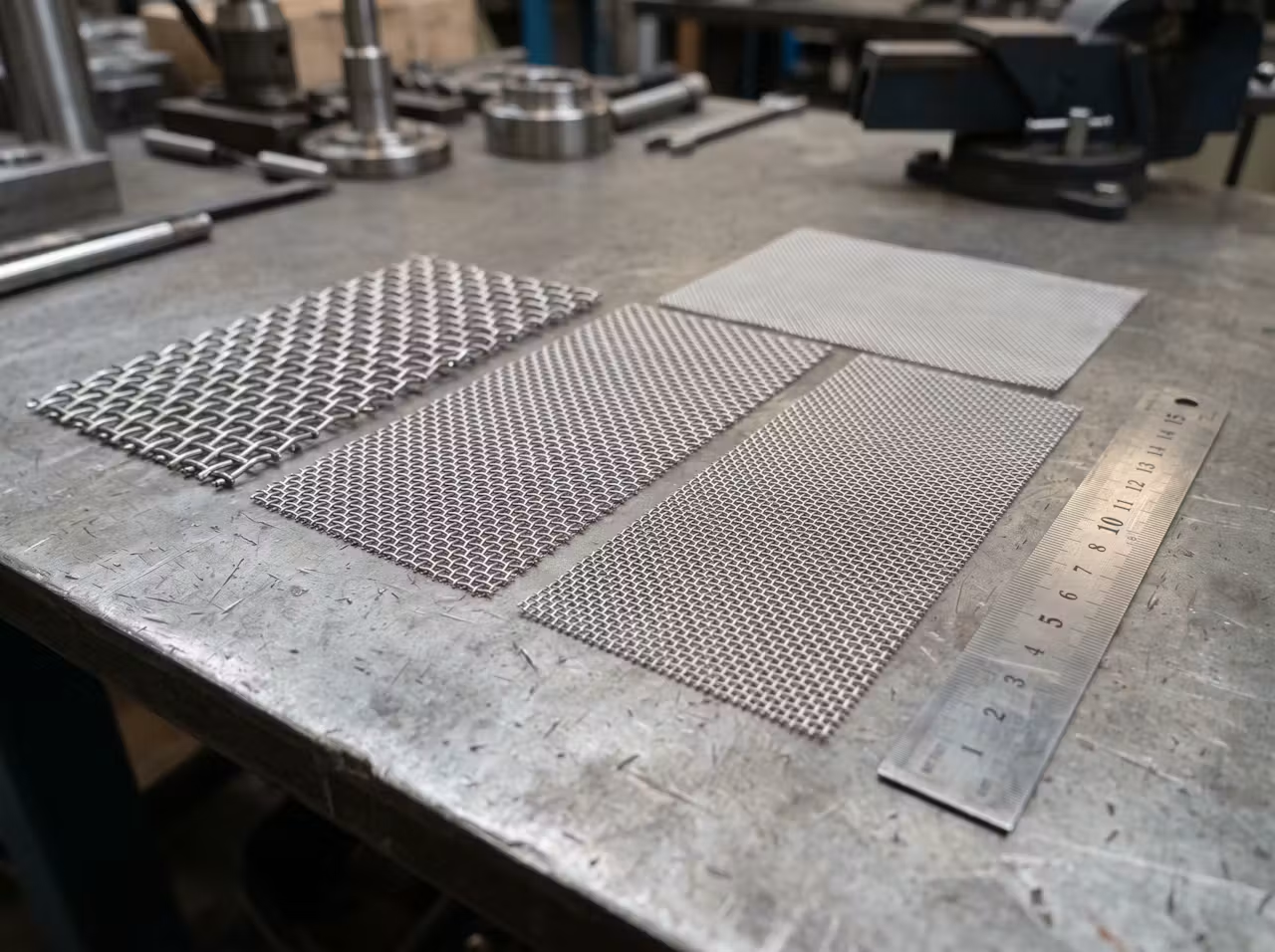
Stainless steel wire cloth samples from coarse market grade to fine bolting cloth on a workbench
Stainless Steel Wire Cloth

Market, Mill and Bolting Cloth Grades

Stainless steel wire cloth is made in three grades, and the difference between them is the wire diameter. Market grade has larger wire diameters and is stronger than bolting or mill grades, but has less open area. Bolting cloth grade has a smaller wire diameter and a high percentage of open area, which provides greater throughput capacity. Mill grade wire diameters are between the market and bolting cloth grades, as a compromise when strength and high capacity are both needed.

All three grades are available in Type 304 and Type 316 stainless steel. Type 304 stainless steel is the standard choice for most industrial applications. Type 316 stainless steel adds molybdenum for higher corrosion resistance against chlorides and many chemicals. Many sizes are also available in Type 430 stainless steel, which is magnetic.

Grade Wire Diameter Open Area
Market Largest Lowest
Mill Medium Medium
Bolting Cloth Smallest Highest

Market grade

Mill grade

Bolting cloth grade

Type 304, 316 and 430

Market Grade Chart

Market Grade Stainless Steel Wire Mesh

Market grade wire cloth uses the heaviest wire for each mesh count. It is the strongest stainless steel screen mesh, with less open area, for abrasive products and heavy loads.

Market grade stainless steel wire cloth, 2 to 635 mesh
Mesh Countper inch Wire Diameterinch Mesh Openinginch Mesh Openingµm Open Area%
2 0.063 0.4370 11100 76.4
3 0.0410 0.2923 7424 76.7
3 0.054 0.2790 7087 70.1
4 0.047 0.2030 5156 65.9
4 0.063 0.1870 4750 56.0
5 0.041 0.1590 4039 63.2
6 0.035 0.1320 3353 62.7
7 0.035 0.1080 2743 57.2
8 0.028 0.0970 2464 60.2
8 0.035 0.0900 2286 51.8
10 0.025 0.0750 1905 56.3
11 0.018 0.0730 1854 64.5
12 0.023 0.0600 1524 51.8
12 0.028 0.0550 1397 43.6
14 0.020 0.0510 1295 51.0
16 0.018 0.0445 1130 50.7
18 0.017 0.0386 980 48.3
20 0.016 0.0340 864 46.2
24 0.014 0.0277 704 44.2
30 0.012 0.0213 541 40.8
35 0.011 0.0176 447 33.8
40 0.010 0.0150 381 36.0
50 0.009 0.0110 279 30.3
60 0.0075 0.0092 234 30.5
80 0.0055 0.0070 178 31.4
100 0.0045 0.0055 140 30.3
120 0.0037 0.0046 117 30.5
150 0.0026 0.0041 104 37.9
180 0.0023 0.0033 84 34.7
200 0.0021 0.0029 74 33.6
250 0.0016 0.0024 61 36.0
270 0.0016 0.0021 53 32.2
325 0.0014 0.0017 43 30.5
400 0.0010 0.0015 38 36.0
510 0.0010 0.0010 25 26.0
635 0.0008 0.0008 20 25.8
Bolting Cloth Chart

Bolting Cloth Stainless Steel Wire Mesh

Bolting cloth grade uses a smaller wire diameter for each mesh count, for a high percentage of open area and greater throughput capacity. It is widely used on flour, food and powder sifters.

Bolting cloth grade stainless steel wire cloth, 14 to 230 mesh
Mesh Countper inch Wire Diameterinch Mesh Openinginch Mesh Openingµm Open Area%
14 0.0090 0.6200 15748 76.4
16 0.0090 0.0535 1359 73.3
18 0.0090 0.0466 1184 70.2
20 0.0090 0.0410 1041 67.2
22 0.0075 0.0380 965 69.7
24 0.0075 0.0342 869 67.2
26 0.0075 0.0310 787 64.8
28 0.0075 0.0282 716 62.4
30 0.0065 0.0268 681 64.8
32 0.0065 0.0248 630 62.7
34 0.0065 0.0229 582 60.7
36 0.0065 0.0213 541 58.7
38 0.0065 0.0198 503 56.7
40 0.0065 0.0185 470 54.8
42 0.0055 0.0183 465 59.1
43 0.0050 0.0183 465 61.6
44 0.0055 0.0172 437 57.4
46 0.0045 0.0172 437 62.9
48 0.0045 0.0163 414 61.5
50 0.0045 0.0155 394 60.1
54 0.0040 0.0145 368 61.5
56 0.0040 0.0138 351 60.2
58 0.0040 0.0132 335 59.0
60 0.0040 0.0127 323 57.8
62 0.0040 0.0121 307 56.5
66 0.0040 0.0112 284 54.2
70 0.0037 0.0106 269 54.9
72 0.0037 0.0102 259 53.8
74 0.0037 0.0098 249 52.7
76 0.0037 0.0095 241 51.7
78 0.0037 0.0091 231 50.6
80 0.0037 0.0088 224 49.6
84 0.0035 0.0084 213 49.8
88 0.0035 0.0079 201 47.9
90 0.0035 0.0076 193 47.8
94 0.0035 0.0071 180 45.0
105 0.0030 0.0065 165 46.9
120 0.0026 0.0058 147 47.3
135 0.0023 0.0051 130 47.4
145 0.0022 0.0047 119 46.4
165 0.0019 0.0042 107 47.1
200 0.0016 0.0034 86 46.2
230 0.0014 0.0029 74 46.0
Mill Grade Chart

Mill Grade Stainless Steel Wire Mesh

Mill grade wire diameters fall between market grade and bolting cloth, as a compromise when strength and high capacity are both needed.

Mill grade stainless steel wire cloth, 3 to 60 mesh
Mesh Countper inch Wire Diameterinch Mesh Openinginch Mesh Openingµm Open Area%
3 0.0410 0.2923 7424 76.7
4 0.0350 0.2150 5461 74.0
5 0.0320 0.1680 4267 70.6
6 0.0280 0.1387 3523 69.6
7 0.0280 0.1149 2918 64.8
8 0.0250 0.1000 2540 64.0
9 0.0230 0.0881 2238 62.7
10 0.0200 0.0800 2032 64.0
11 0.0200 0.0709 1801 61.0
12 0.0180 0.0653 1659 60.8
14 0.0170 0.0544 1382 57.2
16 0.0160 0.0465 1181 55.4
18 0.0150 0.0406 1031 53.4
20 0.0140 0.0360 914 51.8
22 0.0135 0.0320 813 49.6
24 0.0130 0.0287 729 47.4
26 0.0110 0.0275 699 51.1
28 0.0100 0.0257 653 51.8
30 0.0095 0.0238 605 51.0
32 0.0090 0.0223 566 50.9
34 0.0090 0.0204 518 48.1
36 0.0090 0.0188 478 45.8
38 0.0085 0.0178 452 45.8
40 0.0085 0.0165 419 42.6
45 0.0080 0.0142 361 40.8
50 0.0075 0.0125 318 39.1
55 0.0070 0.0112 284 37.9
60 0.0065 0.0102 259 37.5

In accordance with our policy of continuously improving our products, technical specifications are subject to change without notice.

Replacement Screens

Screen Mesh Built Into Your Screens

Screen mesh is only as good as the screen it is built into. AFF builds replacement screens for vibratory separators, round and pretension screens, edged screens and cylindrical and rotary sifters, and supplies screen frames to go with them.

Properly sized and tensioned screens separate accurately and last longer. Send us your equipment make and model, the screen size and the mesh you run, and we will quote the screen.

Technician fitting a stainless steel mesh screen on a vibratory sifter in a food processing plant

Vibratory screens

Round and pretension

Edged screens

Cylindrical and rotary

Industries

Screening Media by Industry

Stainless steel wire mesh and nylon screen mesh for sifting, sizing, straining and filtration in industrial applications across many industries.

Food Processing

Pharmaceutical

Milling

Powder Coating

Manufacturing

Metal Working

Oil Field

Wastewater Treatment

FAQs

Screen Mesh Questions

Tell us your product, equipment and the mesh you run, and we will match the right screening media.

Screening media is the woven mesh stretched across a sifter, separator or screen frame to size and separate material. American Fabric Filter stocks screen mesh in stainless steel wire cloth and nylon, in all the popular mesh sizes.

Mesh count is the number of openings per linear inch of screen. A 100 mesh screen has 100 openings across one inch. The higher the mesh count, the smaller the mesh opening and the finer the particles the screen separates.

Open area is the percentage of the screen surface that is open space between the wires. More open area means more throughput, while a larger wire diameter gives a stronger screen with less open area.

Market grade has the largest wire diameters and is the strongest, with less open area. Bolting cloth grade has a smaller wire diameter and a high percentage of open area for greater throughput capacity. Mill grade wire diameters fall between the two, as a compromise when strength and high capacity are both needed.

All three grades of stainless steel wire cloth are available in Type 304 and Type 316 stainless steel. Many sizes are also available in Type 430 stainless steel, which is magnetic.

Nylon monofilament mesh is used for very fine, precise mesh openings, down to a few microns, and is lightweight. Stainless steel wire cloth is used where the screen needs more strength, abrasion resistance or heat resistance. Tell us your product and equipment and we will recommend the right mesh.

Stainless steel wire mesh resists rust and corrosion in most process environments. Type 316 stainless steel has higher corrosion resistance than Type 304, especially against chlorides and many chemicals. Type 430 stainless steel is magnetic, with lower corrosion resistance than 304 and 316.

Yes. AFF builds replacement screens for vibratory separators, round and pretension screens, edged screens and cylindrical and rotary sifters. Send us your equipment make and model, screen size and mesh, and we will quote the screen.

Screening and Classifying

More Screening Products

Screens, frames and parts for sifters and separators.

Vibratory

Screens for vibratory separators.

Edged Screens

Cotton, vinyl, polyester and steel.

Round & Pretension

Tensioned screens for OEM equipment.

Cleaner Balls

Keep screens from blinding.

Need Help Choosing Screen Mesh?

Send us your product, equipment and the mesh size you need, and we will quote the right screening media.