A cloth media filter is a tertiary filter that pulls secondary effluent through a layer of synthetic cloth to remove the fine suspended solids a clarifier leaves behind. Plants use cloth filters in wastewater treatment to meet tight total suspended solids (TSS), turbidity and phosphorus limits, to protect UV disinfection, and to produce effluent clean enough for reuse. Compared with a deep sand bed, cloth media filtration runs on less driving head, backwashes in minutes instead of half an hour, and fits in a smaller footprint.
This guide explains how tertiary cloth media filters work, how they compare with granular, compressible and microscreen filters, which cloth types are in use, and what to check when you size, operate or re-media a cloth filter.
Where Cloth Media Filtration Fits in Wastewater Treatment
Most municipal wastewater treatment plants and industrial treatment facilities treat water in stages. Primary treatment settles out heavy solids. Secondary treatment uses biology to break down dissolved and suspended organics, followed by a clarifier. Tertiary treatment is whatever comes after that, and its most common form is filtration.
The Water Environment Federation (WEF) notes that tertiary filtration is typically used when effluent TSS limits are below 10 mg/L or turbidity limits are below 2 NTU. Filters also capture particulate organics and nutrients, improve disinfection, protect downstream processes and are often required before reclaimed water can be used where the public has access to it. WEF expects tertiary filtration to keep growing as nutrient removal limits tighten and more plants reuse their effluent, across both municipal and industrial applications.
Cloth filters show up in a few places in a modern municipal or industrial plant:
- Tertiary polishing of secondary effluent ahead of discharge or disinfection
- Phosphorus removal, with a coagulant dosed upstream so the precipitated phosphorus is captured on the cloth
- Water reuse trains where filtered effluent must meet a turbidity standard
- Pretreatment ahead of membranes or reverse osmosis filters to reduce the solids load on more expensive equipment
- Filter retrofits where an older sand or traveling bridge filter needs more capacity inside the same basin
How a Cloth Media Filter Works
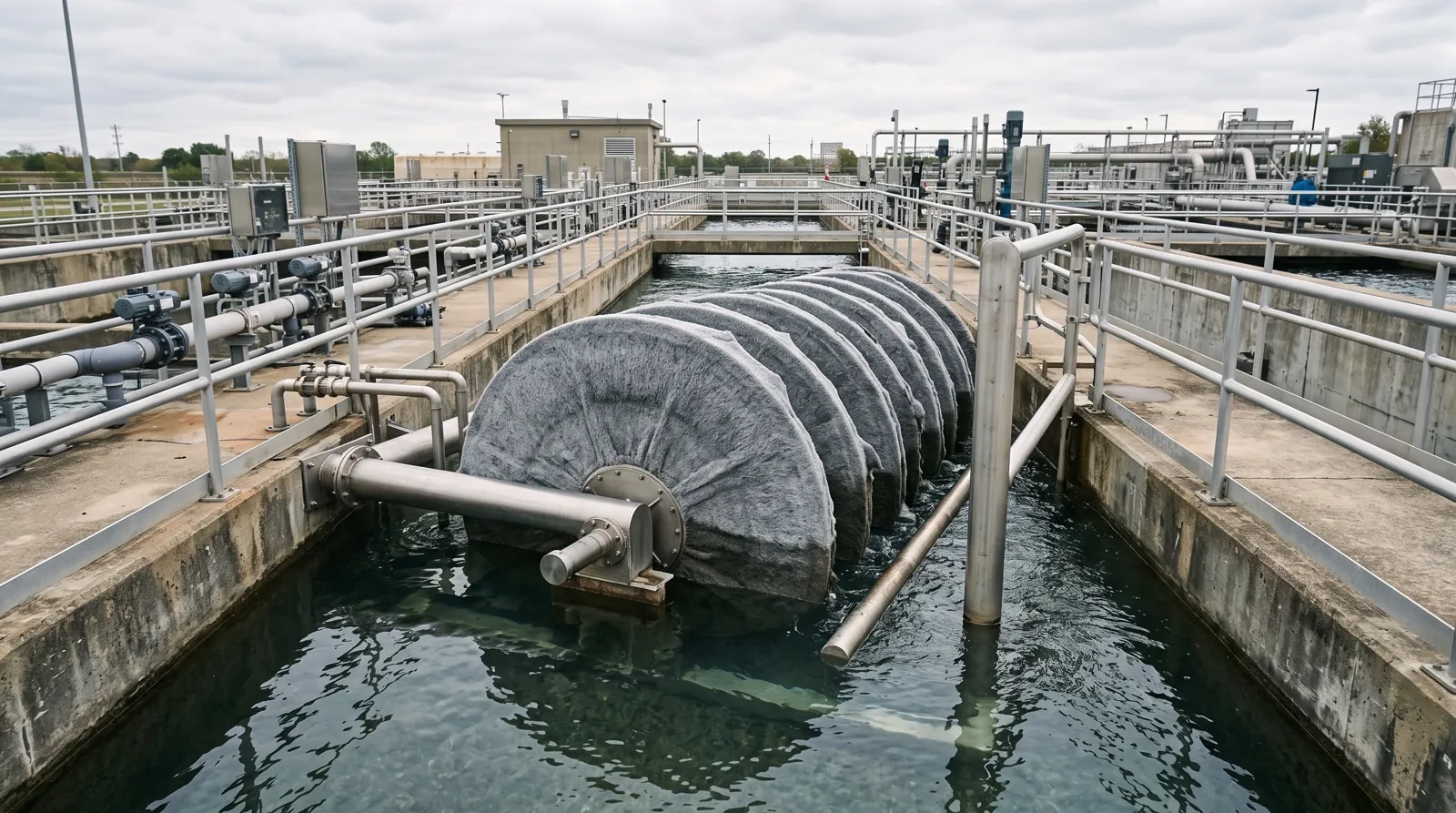
Cloth media filters are surface filters with an outside-in flow path. Water passes through the cloth, solids stay on the outside, and the filtered water collects inside the filter element and flows out. WEF describes the cloth as nylon, acrylic or polyester, roughly 5 to 13 mm thick, with a nominal pore size of 5 to 10 microns.
Disc filters
In the most common layout, cloth-covered discs are mounted on a center tube and submerged in a tank. Filtrate flows through the cloth and into the center tube. The discs stay still while filtering. When solids build up and the water level rises to a set point, the backwash cycle starts: the discs rotate slowly while a suction header vacuums the cloth surface, drawing filtered water back through the media and lifting the captured solids off.
Lateral filters
The same cloth can be mounted on laterals laid across the floor of a basin. Backwash shoes on a traveling platform move along the laterals and vacuum the solids off. Because this layout fits existing rectangular basins, it is a common way to retrofit traveling bridge or automatic backwash sand filters without pouring new concrete.
Drum filters
Drum filters wrap the cloth around a horizontal drum. The drum rotates during cleaning so spray bars or suction can clear the media section by section.
Backwash and solids handling
Per WEF, a cloth filter backwash takes about 6 minutes and sends 1 to 3 percent of forward flow back as reject water. Backwash reject is the only return stream from tertiary filtration. It usually goes back to the head of the plant and commonly carries 500 to 1,000 mg/L of TSS, so it adds a modest solids load to the front of the process. Heavier solids that settle in the tank bottom are pumped out on a separate timer.
Cloth Media Filters vs. Other Tertiary Filters
The table below compares typical design values for the main tertiary filter types, as published in WEF’s Liquid Stream Fundamentals fact sheet on tertiary filtration. These are typical ranges, not guarantees for any specific product.
| Filter type | Media and nominal pore size | Driving head | Peak hydraulic loading | Backwash duration | Backwash reject (% of flow) |
|---|---|---|---|---|---|
| Cloth media, disc or lateral (surface) | Nylon, acrylic or polyester, 5-13 mm, 5-10 micron | 2.5-4 ft | 6-7 gpm/ft² | 6 min | 1-3% |
| Deep bed granular media (depth) | Granular, 3-6 ft, 10 micron | 4-9 ft | 5-8 gpm/ft² | 24 min | 2-3% |
| Continuous backwash granular media (depth) | Granular, 80 in, 10 micron | 2-4 ft | 5 gpm/ft² | Continuous | 2-15% |
| Automatic backwash granular media (depth) | Granular, 12 in, 10 micron | 5 ft | 2-4 gpm/ft² | 0.5-1 min per cell | 5-6% |
| Compressed media (depth) | Synthetic fiber, 30 in, 0.44 mm uncompressed | 6-12 ft | 20-30 gpm/ft² | 20 min | 1-5% |
| Microscreen disc (surface) | Woven stainless steel or polyester, 10-20 micron | 2.5-4 ft | 3-7 gpm/ft² | 0.5-1 min | 0.5-3% |
| Pulsed bed granular media | Granular, 10 in, 10 micron | 6-9 ft | 5 gpm/ft² | 3.5 min | 1-3% |
Source: Water Environment Federation, Municipal Resource Recovery Design Committee, “Liquid Stream Fundamentals: Tertiary Filtration,” fact sheet WSEC-2017-FS-027, Table 1. View the WEF fact sheet (PDF).
A few takeaways for plant engineers:
- Hydraulic loading is comparable to deep bed sand. Cloth runs at 6 to 7 gpm/ft² peak against 5 to 8 for deep bed granular filters, so capacity per square foot of filter area is similar.
- Head and backwash are where cloth wins. Cloth needs 2.5 to 4 ft of driving head versus 4 to 9 ft for deep bed sand, and backwashes in about 6 minutes instead of 24, with no clearwell or separate backwash tank.
- Compressible media runs much faster at 20 to 30 gpm/ft², but needs 6 to 12 ft of head.
- Microscreens use woven mesh with larger openings and much shorter backwash, which suits coarser polishing duty.
Types of Cloth Media
The cloth is the part of a cloth media filter that does the work, and it is the part that wears out. Most tertiary cloth falls into three families:
- Pile cloth media. A backing fabric with a dense layer of fibers standing up from the surface, much like a carpet. Pile cloth media gives the filter effective depth filtration inside a surface filter, which improves solids removal: solids lodge in the pile and the fibers lay down and stand back up during backwash. Pile fabrics are typically polyester, nylon or acrylic, and microfiber versions target finer particles.
- Needle felt. A nonwoven fabric made by mechanically locking fibers together, similar in principle to the felt used in industrial filter media for dust collection.
- Woven monofilament. Polyester (PET) monofilament woven in a twill or plain weave to a defined mesh opening, common on drum filters and microscreens.
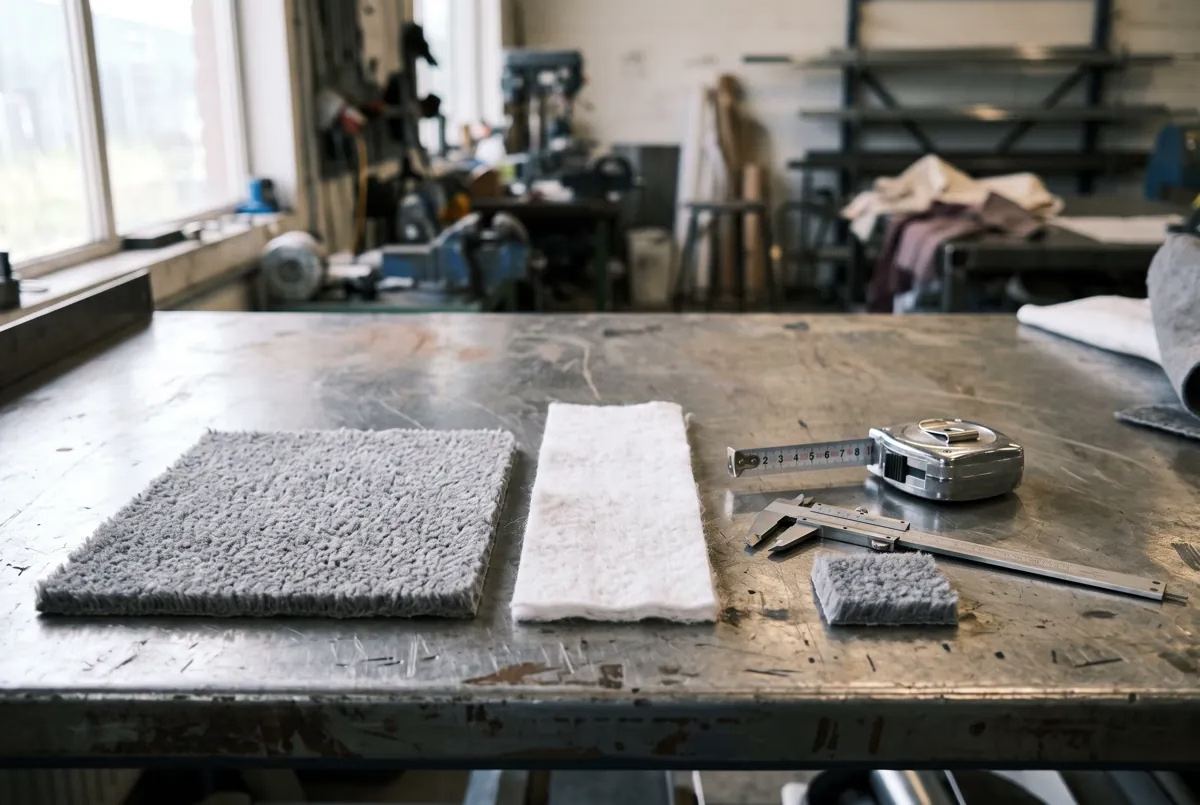
Wastewater Filter Cloth Media: Pile Fabric and Needle Felt
Pile fabrics and needle felts are two of the most common cloth media types in tertiary wastewater filters.
California’s State Water Resources Control Board keeps an Alternative Treatment Technology Report for Recycled Water that lists cloth filters conditionally accepted for Title 22 reuse. Acceptance is tied to a specific filter and a specific cloth at a specific loading rate, so a plant that holds a reuse permit should confirm that any replacement media matches what its permit and engineering report are based on.
Effluent Limits Cloth Filters Are Used to Meet
Turbidity and TSS
Turbidity is the most common performance target. California’s Title 22 Water Recycling Criteria are a widely cited benchmark. They define filtered wastewater from media filtration as water with turbidity that does not exceed an average of 2 NTU over 24 hours, 5 NTU more than 5 percent of the time in 24 hours, and 10 NTU at any time. A cloth filter that is sized correctly and fed stable secondary effluent is designed to meet limits like these.
Phosphorus removal
Biological treatment alone often cannot reach very low total phosphorus permits. Plants add a metal salt coagulant ahead of the tertiary filter so dissolved phosphorus forms particles the cloth can capture. Cloth media filtration has been piloted and designed to meet effluent total phosphorus permits as low as 0.1 mg/L. At those levels, chemical dose, mixing and flocculation time upstream of the filter matter as much as the cloth itself.
Wet weather and primary applications
Manufacturers have also adapted cloth media filtration for primary treatment and for combined sewer overflow and wet-weather flows. These duties carry much higher solids loads than tertiary polishing and use different cloth, tank and backwash designs, so tertiary sizing values do not carry over.
Sizing a Cloth Media Filter
Sizing starts with two numbers: the peak flow and the solids load you expect at the filter influent. From there the designer checks:
- Hydraulic loading rate. Peak flow divided by available cloth area, in gpm/ft². Size at peak flow with one unit or disc out of service, not average flow with everything running.
- Solids loading rate. Influent TSS times flow, per square foot of cloth. High solids and hydraulic loading together drive backwash frequency.
- Regulatory loading limits. Reuse permits may cap loading at the rate the filter was accepted at.
- Upstream stability. Tertiary filters are polishing devices. When the secondary process is upset and sends a slug of solids, any tertiary filter will backwash constantly or bypass.
- Space and head. Low driving head and a compact tank are why many plants with limited land space choose cloth.
Capital and O&M costs for cloth media filtration systems depend heavily on flow, the number of units, chemical feed and how the filter ties into existing hydraulics, so they are best compared on a plant-specific basis.
Operating and Maintaining Cloth Filters
Cloth filters are simple machines, but the media needs attention. Operators and maintenance teams typically watch:
- Backwash frequency. A steady rise in backwashes per day at the same flow and solids load is the first sign the cloth is fouling.
- Effluent turbidity trends. Turbidity that creeps up after backwash can point to worn, torn or poorly seated cloth.
- Chemical and biological fouling. Grease, algae, iron or aluminum floc and biological growth can build up in the fibers. Many plants follow a periodic cleaning procedure with the manufacturer’s approved chemicals.
- Seals and gaskets. A cloth sock that is not sealed at the edges lets unfiltered water bypass the media, which shows up as turbidity spikes.
- Media life. Cloth is a wear item. Replace it on condition, based on backwash frequency, effluent quality and inspection, rather than waiting for a failure.
Filtration for the Rest of Your Wastewater Treatment Plant
A tertiary cloth filter is one step in a plant full of filtration. American Fabric Filter fabricates liquid filtration products in-house for wastewater treatment operations, including filter press cloths for sludge dewatering, replacement belt and drum media for belt filter presses and drum filters, vessel filter bags and cartridges for liquid filtration, and RO pre-filtration. If you are new to dewatering equipment, our guide to how a filter press works is a good place to start.
Because we build to your specs, we can work from your equipment make and model, your current media or a sample. Send us what you are running and we will tell you what we can fabricate. Request a quote or call 1-877-742-3653.
Cloth Media Filter FAQs
What is a cloth media filter in wastewater treatment?
A cloth media filter is a tertiary filter that removes fine suspended solids from secondary effluent by passing it through a synthetic cloth, usually pile fabric, needle felt or woven monofilament. Water flows from the outside of the cloth to the inside, solids stay on the cloth surface, and a vacuum backwash cleans the media.
How does a cloth disc filter backwash?
When solids build up and the water level in the tank reaches a set point, the discs rotate slowly past a suction header. The header vacuums the cloth and pulls filtered water back through the media to lift solids off. WEF lists a typical cloth filter backwash at about 6 minutes, using 1 to 3 percent of forward flow.
What hydraulic loading rate do cloth media filters run at?
WEF lists a typical peak hydraulic loading rate of 6 to 7 gpm/ft² for cloth disc and lateral filters. The rate for a specific project depends on the filter, the cloth, influent solids and any regulatory acceptance limits that apply to reuse.
Are cloth media filters better than sand filters?
Neither is better in every case. Cloth filters run at loading rates similar to deep bed sand filters, but need less driving head, backwash much faster and fit in a smaller footprint. Deep bed granular filters offer more depth for solids storage. The right choice depends on effluent limits, solids load, available head and space, and the existing plant.
Can cloth media filters remove phosphorus?
Cloth filters remove phosphorus that is in particle form. To reach low total phosphorus limits, plants add a coagulant upstream to convert dissolved phosphorus into particles the cloth can capture. Cloth media filtration has been designed to meet effluent total phosphorus permits as low as 0.1 mg/L.
How often does cloth filter media need to be replaced?
Cloth life depends on the media type, the wastewater, chemical exposure and cleaning practices, so there is no single interval. Most plants replace cloth on condition, when backwash frequency climbs and cleaning no longer brings it down, or when inspection shows wear or damage.
Share this guide